BIOGRAPHY
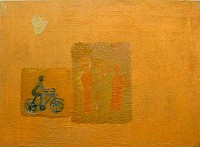
‘Paul Sekete, who lives for his art, offers subtle paintings of puzzling narratives filled with references to daily life, ritual and customs.’ - Elizabeth Larkin
Paul Sekete was born in 1957 in the Free State of South Africa. He grew up in an area where there are abundant examples of KhoiSan rock paintings. Other early influences include the traditional woven mats and pottery his grandmother and other family members made.
After his schooling, Sekete worked as a miner for a year prior to joining the Katlehong Art Centre. He was a self-trained artist, and worked both as a sculptor and as a painter. Sekete participated in numerous group exhibitions in South Africa, Namibia and abroad. His first solo exhibition was held at Gallery 21 in Johannesburg in 1990. His media includes clay, wood, linocut, woodcut, oil and acrylic, while some of his sculptures have been cast in bronze.
Echoing southern African rock art, Sekete used distortion, elongation, and disproportionate scale to describe the human form, and combined these with well-defined linear shapes. Sekete's early imagery often conjures up a sense of the neon township – forms remembered from a street corner, somewhere. His light brushstrokes evoke the monumental out of the ordinary; the extraordinariness of the ordinary. ‘A hat at a jaunty angle, a bright sacred necklace, oh, and there's a man running and that lady, she's waving … greeting!’
In 1999 Paul Sekete left the townships of Johannesburg for Cape Town, and divided his time between there and his home town in the Free State. Not surprisingly, the neon township made way for a more earthy, rustic palette, drawing on the suggestive, mythic qualities of KhoiSan art. Sekete evolved his language, a secret script that described his world and invites us to journey with him to places and possibilities that are both real and imagined; familiar yet mysterious.
Paul Sekete died after a long struggle with illness in July 2010.
 Download Complete CV (PDF)